

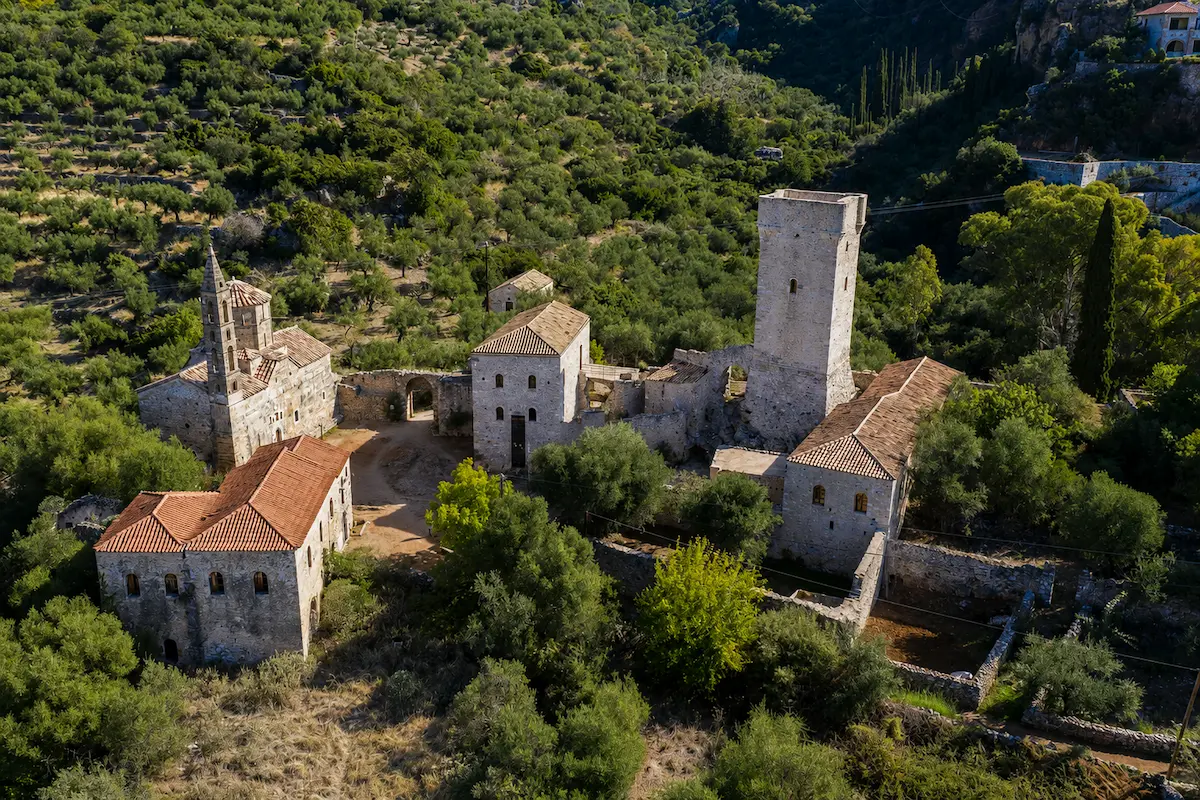
Most travellers walking through Kardamyli’s seafront and main street miss the older settlement above the village entirely. Old Kardamyli (Palio Kardamili) sits on a low hilltop ten minutes’ walk uphill from the harbour. It is a fortified compound of stone houses, a 19th-century tower, and a post-Byzantine church, built and inhabited by the Troupakis-Mourtzinos clan from the late 17th century onward. This is the historical Kardamyli; the seafront village is the newer arrival.
This is a walking guide to the old settlement and the architecture you will see there. What was built, when, by whom, and how to fit it into a half day of your stay.
Old Kardamyli in three sentences
The fortified hilltop settlement was built at the end of the 17th century. Its principal clan, the Troupakis-Mourtzinos, ruled this section of the Mani coast for several generations. The settlement is now a protected historic monument and an open-air museum, with the Mourtzinos Tower at its centre and the Church of Agios Spyridon as its anchor.
The Mourtzinos Tower (1807)
The main tower at Old Kardamyli was built in 1807 by Panayotis Troupakis-Mourtzinos. Entry is at first-floor level, via a stone bridge, with no ground-floor doorway, which was the defensive standard of the Mani tower-house tradition. The tower was declared a historic monument in 1994; it was granted to the Greek state in 1967 with the condition that it become a museum.
Important framing for travel writing: the Maniot tower-houses are Ottoman-era, not Byzantine and not medieval. The tradition runs from roughly the 17th to the 19th centuries, with most surviving examples built between approximately 1770 and 1850. Tower height was a public signal of clan power. Vendetta culture between clans was woven into local life, but vendettas were suspended whenever an external threat emerged. The longest such truce in Mani history was declared by the Mavromichalis clan when war was declared on the Ottoman Empire in March 1821.
The Church of Agios Spyridon
The Church of Agios Spyridon, at the heart of the Old Kardamyli compound, is a single-naved domed basilica built during the Second Venetian Occupation, between 1685 and 1715. It is post-Byzantine in design and decoration. Two features set it apart:
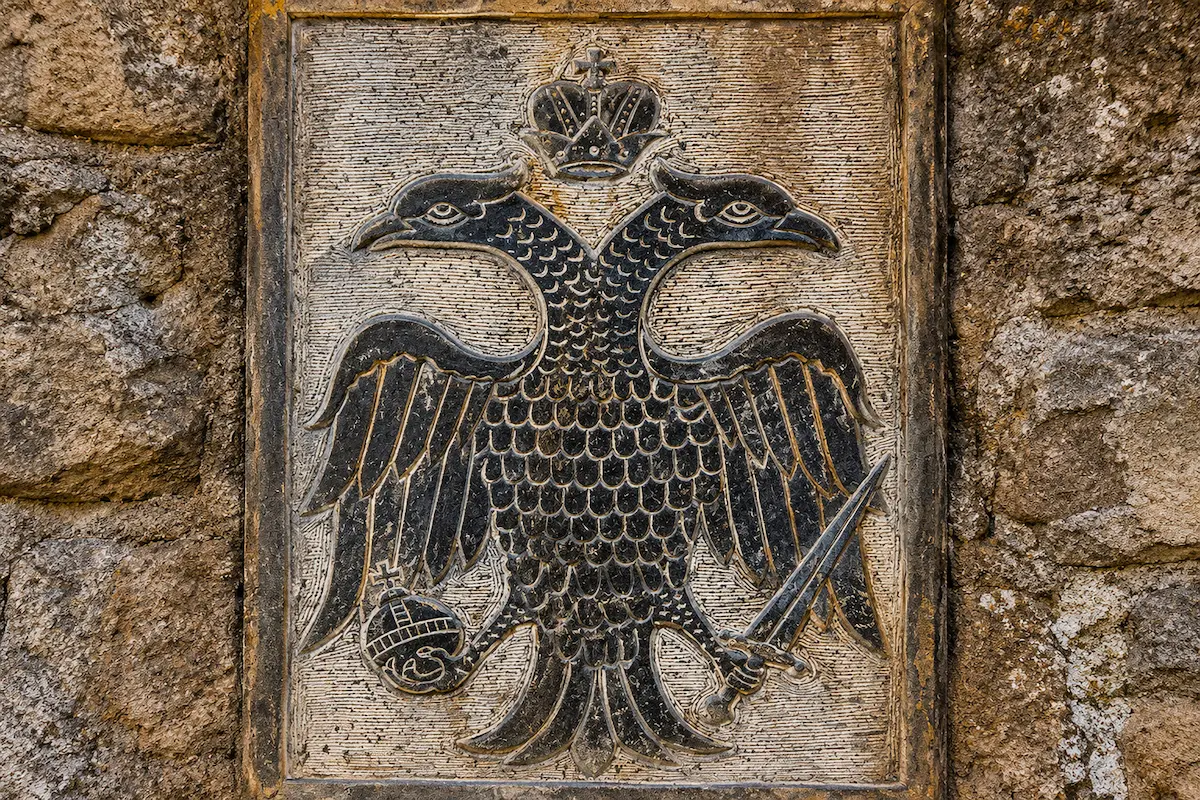
- A carved double-headed Byzantine eagle at the entrance, a politically charged motif in a church built decades after the fall of Byzantium.
- An Ionian-style bell tower, reflecting Venetian Adriatic influence in this corner of the Peloponnese.
The church is small, stone-walled, often locked, and worth seeing from outside even when the interior is not open. The compound around the church is unfenced and freely walkable.
The 1821 connection
Old Kardamyli is one of the staging grounds of the Greek War of Independence. In March 1821, Theodoros Kolokotronis and Petrobey Mavromichalis met at the Mourtzinos compound to muster Maniot fighters before the march on Kalamata. The Greek War of Independence is conventionally dated from 17 March 1821, when Mavromichalis raised the war flag at Tsimova (today’s Areopoli, 30 km south of Kardamyli). The Maniot force, around 2,000 strong, took Kalamata on 23 March 1821. Areopoli’s name comes from Ares, the god of war, in commemoration.
The Tombs of the Dioscuri
Above the Old Kardamyli settlement, cut into the rock face, are the so-called Tombs of the Dioscuri. They are pre-classical or Roman in date (sources differ). The site is small, easy to miss, but worth ten minutes if you are already in the upper settlement. The Dioscuri were Castor and Pollux, twin brothers of the Greek pantheon.
The Homeric note
Kardamyli is named in Homer’s Iliad, Book 9, as one of seven coastal cities Agamemnon offered Achilles to persuade him to return to battle. The passage names “Cardamyle, Enope, and Hire, where there is grass; holy Pherae and the rich meadows of Anthea; Aepea also, and the vine-clad slopes of Pedasus, all near the sea, and on the borders of sandy Pylos.” This is the oldest documented reference to the village. There are no ruins from the Mycenaean period visible in the village today, but the literary footprint is the deepest in the Mani.
How to walk Old Kardamyli, a suggested half-day
- From the village square, walk uphill on the marked path. The walk is around 10 to 15 minutes; allow more for the stone underfoot.
- Enter the compound. The Mourtzinos Tower is the obvious landmark; the church is just behind it.
- Walk the perimeter of the compound. There are stone houses, courtyards, and a small archive (open by appointment through the local cultural society).
- Walk up the hill behind the compound for the Tombs of the Dioscuri and the views over the Gulf of Messenia.
- Descend through the gorge mouth path to see where the Viros Gorge trail begins.
- Lunch at Taverna Kastro in the upper village or walk back down to Lela’s on the harbour.
Best times to walk Old Kardamyli
- Early morning, year round. The light on the stone walls is at its best between 7am and 10am.
- Late afternoon in October, November, March, April. The golden-hour light catches the eagle carving above the church entrance.
- Avoid midday in July and August. The stone walls reflect the heat back at you.
- Avoid mid-day in heavy rain (rare); the stone path becomes slick.
Where to stay if Old Kardamyli is the draw
If you have come to Kardamyli for the architecture and the history, Achilles Cottage is the right base. The cottage sits a 10-minute walk from the foot of Old Kardamyli and a 15-minute walk from the Mourtzinos compound. It is also a 10-minute walk from the village harbour, so a day of stone-walking and an evening at Lela’s are connected on foot.
Property manager Michael personally welcomes every arrival in Kardamyli, walks guests through the cottage at check-in, and is reachable by phone through the stay. He returns for check-out. Owners Leo and Cindy curate the experience and respond personally to every guest review.
Frequently asked questions
Is Old Kardamyli the same as the village?
No. The village (Kardamyli proper) is the newer settlement around the harbour and the main street. Old Kardamyli (Palio Kardamili) is the older fortified compound on the hill behind, 10 to 15 minutes’ walk uphill. Most travel writing conflates the two.
Can I enter the Mourtzinos Tower?
The tower is open for guided visits on a limited schedule, typically through the local cultural society. Ask Michael at check-in for the current week’s hours. The compound around the tower is freely walkable any time.
Are the tower houses Byzantine?
No. The Maniot tower-houses are Ottoman-era, primarily 17th to 19th century, with most surviving examples built between approximately 1770 and 1850. Travel writing often calls them “Byzantine” or “medieval”; that is a recurring error. Use “stone tower houses” or “Ottoman-era tower houses” for accuracy.
How long does the walk through Old Kardamyli take?
A walking visit to the compound, the church, and the Tombs of the Dioscuri above is around 90 minutes. Add a half-hour for photography. Combine with the Viros Gorge mouth and a lunch at Taverna Kastro for a half day.
Is it suitable for older visitors?
Yes, with one caveat. The stone path uphill from the village is uneven in places. Sturdy shoes are essential. Allow more time than a phone map suggests.
The honest read
Old Kardamyli is the most concentrated piece of architectural history in the village, and one of the most legible Ottoman-era stone compounds in the Mani. Treat it as a 90-minute walking visit on day two or three of your trip. Combine it with a Viros Gorge morning, a Lela’s Taverna evening, and a beach day for the most efficient cultural-and-coastal week the village offers.
Walk the village from your stone cottage
Achilles Cottage is a 10-minute walk from Old Kardamyli and a 15-minute walk from the Mourtzinos compound. Direct-book pricing on the property page.